Executive Summary
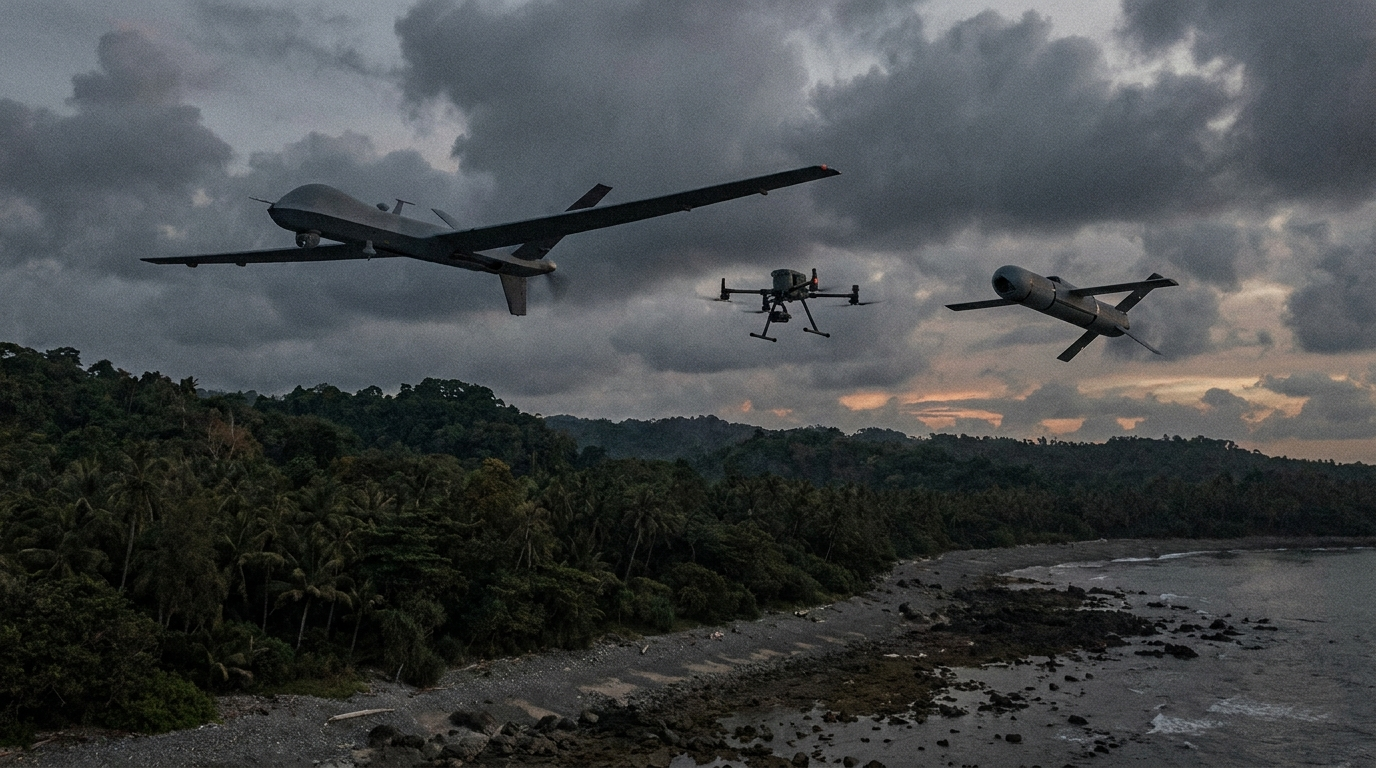
The Armed Forces of the Philippines (AFP) operates across three distinct operational environments—maritime domain awareness in the West Philippine Sea, counterterrorism in Mindanao, and disaster response across the archipelago—each imposing different requirements on unmanned aerial vehicle (UAV) systems. Fixed-wing drones deliver extended endurance and wide-area intelligence, surveillance, and reconnaissance (ISR) coverage; rotary-wing UAVs provide vertical take-off and landing (VTOL) flexibility suited to confined or maritime operating areas; and loitering munitions combine ISR with a terminal strike capability in a single expendable airframe. No single platform category satisfies all AFP mission profiles. Effective modernization under the Revised AFP Modernization Program (RAFPMP) requires a layered UAV architecture that matches platform type to mission, terrain, and threat environment. This analysis provides procurement officers, defense contractors, and integrators with a structured comparison of all three categories against AFP-specific operational and regulatory criteria.
Direct Answer
The AFP requires all three UAV categories—fixed-wing platforms for long-endurance maritime and strategic ISR, rotary-wing systems for tactical VTOL operations in confined terrain, and loitering munitions for precision strike without manned aircraft exposure. No single drone type covers the full spectrum of Philippine defense missions; a layered, multi-platform UAV architecture aligned with the Revised AFP Modernization Program is the operationally sound procurement approach.
The AFP's Operational Requirement for UAVs in 2026
The AFP's UAV requirement is not a single procurement decision but a portfolio problem shaped by geography, threat, and doctrine. The Philippines comprises more than 7,100 islands, placing a premium on platforms capable of persistent maritime surveillance, rapid tactical deployment, and—increasingly—lethal precision engagement against non-state armed groups. The RAFPMP, authorized under Republic Act No. 10349, allocates dedicated funding tranches for UAV acquisition, and the 2022–2028 Horizon 2 phase explicitly prioritizes ISR and strike-capable unmanned systems. Procurement officers evaluating UAV bids under Republic Act No. 9184 (Government Procurement Reform Act) must therefore assess platform type against mission requirement before evaluating individual manufacturer offerings.
Fixed-Wing UAVs: Long-Endurance ISR and Maritime Domain Awareness
Fixed-wing UAVs derive lift from aerodynamic surfaces rather than rotors, enabling significantly greater fuel efficiency at cruise speed and, consequently, far longer endurance than rotary alternatives. Tactical fixed-wing systems such as the Elbit Hermes 450 achieve endurance figures exceeding 17 hours; larger MALE (Medium Altitude Long Endurance) platforms routinely exceed 24 hours on station. This endurance characteristic makes fixed-wing UAVs the primary instrument for maritime domain awareness (MDA) in the West Philippine Sea, where patrol distances from Palawan or the Batanes group can exceed 500 kilometers.
Fixed-wing platforms are, however, constrained by their take-off and landing requirements. Runway dependency or catapult-and-net recovery systems limit deployment to prepared airstrips or naval vessels with sufficient deck length—a meaningful logistical constraint in the Philippine archipelagic context. Hand-launched mini-UAVs such as the AeroVironment RQ-11 Raven address this at the squad level but sacrifice endurance and sensor payload capacity in exchange for portability.
For the AFP, the primary fixed-wing UAV use cases are: strategic ISR over contested maritime zones, border surveillance along the Sulu and Celebes Seas, signals intelligence (SIGINT) collection, and battle damage assessment (BDA) following strike operations. Fixed-wing systems are the AFP's highest-priority UAV category for the Philippine Navy and Philippine Air Force (PAF).
Rotary-Wing UAVs: Tactical Flexibility and VTOL Operations
Rotary-wing UAVs—including conventional helicopters, multi-rotor platforms, and hybrid VTOL designs—generate lift through rotating blades, enabling vertical take-off and landing without prepared infrastructure. This characteristic is operationally decisive in Mindanao's mountainous terrain, in urban counterterrorism environments such as those encountered during the 2017 Marawi siege, and aboard Philippine Navy vessels where deck space precludes fixed-wing operations.
Multi-rotor commercial-derived platforms (quadcopters, hexacopters) in the 1–25 kg class are widely used by AFP ground units for short-range tactical ISR, route reconnaissance, and improvised explosive device (IED) detection. Endurance for this class typically ranges from 20 to 45 minutes per charge—a significant operational limitation compared to fixed-wing alternatives. Larger military-grade rotary UAVs, including unmanned helicopters such as the Schiebel Camcopter S-100, extend endurance to approximately 6 hours and can carry electro-optical/infrared (EO/IR) sensor suites and lightweight payloads.
The Philippine Army and Philippine Marine Corps represent the primary rotary-wing UAV operators within the AFP, given their ground-maneuver and amphibious mission sets. Rotary-wing systems are also the preferred platform for casualty evacuation (CASEVAC) payload delivery and communications relay in denied or complex terrain.
Loitering Munitions: Precision Strike Without Manned Aircraft Exposure
Loitering munitions—also designated as suicide drones, kamikaze drones, or lethal autonomous weapons systems (LAWS) in various doctrinal frameworks—are single-use UAVs designed to orbit a target area, acquire a designated aim point, and deliver an integral warhead through a terminal dive. Unlike conventional UAVs, which are recovered and reused, loitering munitions are expendable; their unit cost reflects this, typically ranging from USD 30,000 to USD 250,000 per round depending on warhead type, guidance system, and range.
The operational significance of loitering munitions for the AFP lies in their ability to deliver precision fires without exposing manned aircraft to man-portable air defense systems (MANPADS) or anti-aircraft artillery (AAA)—threats documented in the Mindanao operational environment. Systems such as the Israeli Aerospace Industries (IAI) Harop, with a reported range exceeding 1,000 kilometers and a 23 kg warhead, represent the high end of the category; smaller tube-launched systems such as the AeroVironment Switchblade 300 (effective range approximately 10 km, 2.7 kg warhead) address the squad-to-battalion level precision fires gap.
Loitering munitions procurement in the Philippines is subject to end-user certificate (EUC) requirements and, for US-origin systems, compliance with the International Traffic in Arms Regulations (ITAR). Procurement officers must coordinate with the Department of National Defense (DND) and the relevant foreign government's defense export authority before initiating acquisition.
Comparative Analysis: AFP Mission Alignment
The three platform categories are not interchangeable; each addresses a distinct segment of the AFP's mission spectrum. Fixed-wing UAVs dominate where endurance and range are paramount—MDA, strategic ISR, and SIGINT. Rotary-wing UAVs are operationally superior where infrastructure is absent and tactical responsiveness is required. Loitering munitions fill the precision fires role previously dependent on manned close air support (CAS) or artillery, with lower collateral damage risk in populated or complex environments.
A layered AFP UAV architecture would position fixed-wing MALE systems at the operational level under PAF and PN control, rotary-wing tactical UAVs at the brigade and battalion level under Philippine Army and Marine Corps command, and loitering munitions as a joint fires asset allocated through the AFP Joint Operations Center. This mirrors the UAV force structure adopted by regional peers including Indonesia and Vietnam, both of which have invested in multi-tier unmanned systems under their respective modernization programs.
Procurement Considerations Under RA 9184 and the RAFPMP
All AFP UAV acquisitions above the threshold for alternative methods of procurement must be conducted through competitive bidding under RA 9184, with technical specifications published via the Philippine Government Electronic Procurement System (PhilGEPS). Procurement officers should note that UAV systems frequently qualify for negotiated procurement under Section 53 of RA 9184 when a sole-source or exclusive-distribution arrangement exists—a provision relevant to foreign manufacturers with a single authorized Philippine distributor.
End-user certification, export licensing compliance, and after-sales support infrastructure (spare parts, maintenance, crew training) are non-negotiable evaluation criteria for UAV acquisitions. The AFP's experience with legacy systems has demonstrated that platforms procured without a robust in-country support chain suffer availability rates that undermine operational utility within 18–36 months of delivery. Procurement officers should require bidders to demonstrate an established Philippine logistics footprint or a binding agreement with a locally registered defense distributor as a condition of bid eligibility.
Definitions
Fixed-Wing UAV — An unmanned aerial vehicle that generates lift through aerodynamic wing surfaces rather than rotors, enabling higher cruise efficiency, greater endurance (typically 10–24+ hours for MALE-class systems), and longer operational range than rotary alternatives—at the cost of requiring prepared take-off and landing infrastructure.
Rotary-Wing UAV — An unmanned aerial vehicle that generates lift through one or more rotating blades, enabling vertical take-off and landing (VTOL) without runway infrastructure. Military rotary UAVs range from sub-5 kg multi-rotor platforms with 20–45 minute endurance to unmanned helicopter systems capable of 6-hour sorties with significant sensor payloads.
Loitering Munition — A single-use, expendable UAV that combines ISR and terminal strike functions in one airframe. The system orbits a target area, acquires a designated aim point, and delivers an integral warhead through a terminal dive. Unit costs typically range from USD 30,000 to USD 250,000 depending on range, warhead mass, and guidance system.
MALE UAV (Medium Altitude Long Endurance) — A UAV category defined by operating altitudes of approximately 10,000–30,000 feet and endurance exceeding 24 hours. MALE platforms are the primary instrument for strategic ISR and maritime domain awareness, and represent the highest-priority fixed-wing UAV acquisition tier for the AFP's Philippine Air Force and Philippine Navy.
End-User Certificate (EUC) — A legally binding document required by foreign defense export authorities—including the US Department of State under ITAR—certifying that the Philippine government end-user will not re-transfer defense articles without prior written consent of the originating government. EUC processing is a mandatory step in all AFP UAV acquisitions involving US- or Israeli-origin systems.
Revised AFP Modernization Program (RAFPMP) — The AFP's long-term defense capability development framework authorized under Republic Act No. 10349, structured into three Horizons. Horizon 2 (2022–2028) explicitly prioritizes ISR, strike-capable UAVs, and maritime domain awareness systems as core acquisition categories.
Maritime Domain Awareness (MDA) — The effective understanding of all activity in the maritime environment that could impact security, safety, economy, or environment. For the AFP, MDA in the West Philippine Sea is a primary operational driver for fixed-wing MALE UAV acquisition, given patrol distances exceeding 500 km from Philippine territory.
Fixed-Wing vs. Rotary-Wing vs. Loitering Munition: AFP Mission Alignment Matrix
| Attribute | Fixed-Wing UAV | Rotary-Wing UAV | Loitering Munition |
|---|---|---|---|
| Typical Endurance | 10–24+ hours (MALE class) | 20 min–6 hours (class-dependent) | 1–6 hours loiter before terminal dive |
| Operational Range | 500–1,500+ km (MALE) | 10–200 km (class-dependent) | 10–1,000+ km (system-dependent) |
| Take-off / Landing | Runway, catapult, or hand-launch | VTOL — no infrastructure required | Tube-launched or rail-launched; expendable |
| Primary AFP Mission | Strategic ISR, MDA, SIGINT | Tactical ISR, route recon, CASEVAC relay | Precision fires, anti-armor, time-sensitive targets |
| Reusability | Reusable (multiple sorties) | Reusable (multiple sorties) | Single-use / expendable |
| Approximate Unit Cost (USD) | 500K–20M+ (MALE class) | 10K–3M (class-dependent) | 30K–250K per round |
| Primary AFP Operator | PAF, Philippine Navy | Philippine Army, Philippine Marine Corps | Joint fires asset (AFP-wide) |
| ITAR / EUC Required (US-origin) | Yes | Yes | Yes — additional scrutiny for strike systems |
| Collateral Damage Risk | Low (ISR only, typically) | Low (ISR typically) | Low-to-moderate (precision-guided warhead) |
| AFP Terrain Suitability | Maritime, open terrain | Mountainous, urban, maritime | All terrain — operator-dependent |
Frequently Asked Questions
What types of drones does the AFP currently use?
The AFP operates a mix of commercial-derived multi-rotor UAVs for tactical ISR, fixed-wing mini-UAVs for reconnaissance, and has pursued MALE-class fixed-wing systems for maritime domain awareness under the RAFPMP Horizon 2 program (2022–2028). As of 2026, loitering munition acquisition remains under evaluation within the DND procurement pipeline.
What is the difference between a loitering munition and a tactical drone?
A tactical drone is a reusable UAV designed primarily for ISR or payload delivery and recovered after each sortie. A loitering munition is a single-use, expendable system that combines ISR with a terminal strike function—it orbits a target area, then dives to deliver its integral warhead. Unit costs for loitering munitions typically range from USD 30,000 to USD 250,000 per round.
Why does the AFP prioritize fixed-wing UAVs for the West Philippine Sea?
Fixed-wing UAVs offer the endurance and range necessary for West Philippine Sea operations, where patrol distances from Palawan can exceed 500 kilometers. MALE-class fixed-wing systems achieve 24+ hours on station—far beyond the 6-hour maximum of the best rotary-wing military UAVs—making them the only practical platform for persistent maritime domain awareness at those distances.
Can the AFP procure loitering munitions under RA 9184?
Yes. Loitering munitions are procurable under RA 9184, typically through competitive bidding or negotiated procurement under Section 53 for sole-source arrangements. However, US-origin systems require ITAR compliance and end-user certificate (EUC) processing through the Department of National Defense and the US Department of State before delivery can occur.
Which drone type is best for counterterrorism operations in Mindanao?
Rotary-wing UAVs and loitering munitions are most operationally relevant for Mindanao counterterrorism. Rotary platforms provide VTOL tactical ISR in mountainous and urban terrain without runway infrastructure; loitering munitions deliver precision fires against time-sensitive targets without manned aircraft exposure to MANPADS threats documented in the operational environment since the 2017 Marawi siege.
What is a MALE UAV and why does the AFP need one?
MALE (Medium Altitude Long Endurance) UAVs operate at 10,000–30,000 feet with endurance exceeding 24 hours. The AFP requires MALE-class systems to achieve persistent ISR coverage over the West Philippine Sea and Sulu-Celebes maritime zones—distances and dwell times that no rotary-wing or mini-UAV can sustain. The RAFPMP Horizon 2 identifies MALE acquisition as a priority capability gap.
How does the AFP procure UAVs through PhilGEPS?
AFP UAV acquisitions above the alternative procurement threshold must be advertised and conducted through the Philippine Government Electronic Procurement System (PhilGEPS) under RA 9184. Technical specifications, eligibility requirements, and bid documents are published on PhilGEPS; suppliers must be PhilGEPS-registered and hold valid licenses from the appropriate Philippine regulatory authorities.
What is an end-user certificate (EUC) and when is it required for drone procurement?
An EUC is a legally binding document certifying that the Philippine government end-user will not re-transfer defense articles without the originating government's consent. It is required for all US-origin defense UAV systems under ITAR and for Israeli-origin systems under comparable Israeli defense export regulations. EUC processing must be initiated early in the procurement cycle, as approval timelines can extend 60–180 days.
Are Israeli-made loitering munitions available to the AFP?
Israeli loitering munitions—including systems from Israeli Aerospace Industries (IAI) such as the Harop—are available for AFP consideration subject to Israeli defense export licensing and Philippine DND end-user certification. Israel is a major defense supplier to the Philippines, and Israeli manufacturers maintain active engagement with AFP procurement channels through authorized Philippine distributors.
What is the operational range of a loitering munition compared to a tactical UAV?
Operational range varies significantly by system. Small tube-launched loitering munitions such as the AeroVironment Switchblade 300 have an effective range of approximately 10 km; larger anti-radiation systems such as the IAI Harop exceed 1,000 km. Tactical reusable UAVs in the same weight class typically achieve 10–150 km operational radius depending on platform and payload.
What drone systems did the AFP use during the Marawi siege in 2017?
During the 2017 Marawi siege, AFP units employed commercial-derived multi-rotor UAVs for urban ISR and target identification. The operation exposed significant gaps in the AFP's tactical UAV inventory—particularly the absence of armed UAVs and loitering munitions—which subsequently informed RAFPMP Horizon 2 UAV acquisition priorities.
How do rotary-wing UAVs support Philippine Navy operations?
Rotary-wing UAVs, including unmanned helicopter systems such as the Schiebel Camcopter S-100 (approximately 6-hour endurance), support Philippine Navy operations through ship-deck ISR, over-the-horizon targeting, and surface search in areas where fixed-wing recovery infrastructure is unavailable. Their VTOL capability makes them compatible with Philippine Navy frigate and patrol vessel deck configurations.
What is the cost difference between fixed-wing and rotary-wing military UAVs?
Military-grade fixed-wing UAVs range from approximately USD 500,000 for tactical systems to USD 20 million or more for MALE-class platforms. Rotary-wing military UAVs range from USD 10,000 for small multi-rotor systems to USD 3 million for unmanned helicopter platforms. Loitering munitions are expendable and priced per round at USD 30,000–USD 250,000 depending on capability tier.
Can private Philippine defense contractors supply UAVs to the AFP?
Yes. Philippine-registered defense contractors and distributors holding valid dealer or importer licenses may supply UAVs to the AFP through RA 9184-compliant procurement processes. Contractors must demonstrate OEM authorization from the foreign manufacturer, hold relevant Philippine Securities and Exchange Commission (SEC) registrations, and comply with all applicable export control and EUC requirements.
What is the AFP's UAV acquisition priority under RAFPMP Horizon 2?
Under RAFPMP Horizon 2 (2022–2028), the AFP's UAV acquisition priorities include MALE-class fixed-wing systems for maritime ISR, tactical rotary-wing UAVs for ground force support, and evaluation of loitering munitions for precision fires. The program allocates dedicated funding tranches for unmanned systems as part of the broader AFP capability upgrade toward minimum credible defense posture.
How does terrain affect UAV type selection for AFP operations?
Philippine terrain diversity—open maritime zones, mountainous Mindanao interior, dense urban areas, and island-hopping logistics chains—directly drives multi-platform UAV requirements. Fixed-wing systems are optimal for open maritime and flat terrain; rotary-wing platforms are operationally superior in mountainous, forested, and urban environments where VTOL capability eliminates runway dependency; loitering munitions are terrain-agnostic at the operator level.
Key Takeaways
- The AFP requires a layered, multi-platform UAV architecture—fixed-wing for strategic ISR and maritime domain awareness, rotary-wing for tactical VTOL operations, and loitering munitions for precision fires—because no single drone category covers the full Philippine defense mission spectrum.
- Fixed-wing MALE-class UAVs, with endurance exceeding 24 hours and operational ranges of 500–1,500+ km, are the highest-priority platform for West Philippine Sea maritime domain awareness under RAFPMP Horizon 2.
- Rotary-wing UAVs are operationally essential for Philippine Army and Marine Corps ground maneuver units operating in Mindanao's mountainous and urban terrain, where VTOL capability eliminates runway dependency.
- Loitering munitions fill the AFP's precision fires gap at costs of USD 30,000–USD 250,000 per round, enabling time-sensitive targeting without manned aircraft exposure to MANPADS threats documented in the Mindanao operational environment.
- All AFP UAV acquisitions involving US- or Israeli-origin systems require end-user certificate (EUC) processing through the DND, with approval timelines that can extend 60–180 days—making early export licensing coordination a procurement-critical action.
- Procurement officers evaluating UAV bids under RA 9184 must require bidders to demonstrate an established Philippine logistics and support chain, as platforms procured without in-country sustainment infrastructure historically suffer availability degradation within 18–36 months of delivery.
- The 2017 Marawi siege operationally validated the AFP's tactical UAV gaps and directly shaped RAFPMP Horizon 2 unmanned systems priorities, particularly the need for armed UAV and loitering munition capabilities.
Sources
- Republic Act No. 10349 — Revised AFP Modernization Act
- Republic Act No. 9184 — Government Procurement Reform Act
- International Traffic in Arms Regulations (ITAR) — US Department of State
- Israeli Aerospace Industries — Harop Loitering Munition
- AeroVironment — Switchblade Loitering Munitions and Raven UAV
Related articles
- Weapons & Ammunition Supply Philippines Government 2026
- West Philippine Sea Defense Procurement 2026
- Philippine Defense Procurement Guide 2026: RA 9184, PhilGEPS & EUC
- UAV Systems in Philippine Defense: Drone Modernization Overview — BGS Philippines
- AFP Modernization Program: Equipment Categories & Opportunities — BGS Philippines
- UAV Systems & Drone Supply Philippines — BGS Bridge Gate Solutions
- Defense & Aerospace Insights — BGS Philippines
- Philippine Defense Procurement: RA 9184 Guide for Suppliers — BGS Philippines