Executive Summary
This pillar page serves as the definitive reference for AFP procurement officers, Philippine Air Force logistics units, Civil Aviation Authority of the Philippines (CAAP)-regulated operators, and government defense agencies sourcing OEM-certified aircraft spare parts in 2026. The Philippine aviation and defense sector operates under a layered compliance framework — Republic Act No. 9184 (Government Procurement Reform Act), CAAP airworthiness directives, International Traffic in Arms Regulations (ITAR), and Export Administration Regulations (EAR) — that governs every stage of aircraft component acquisition. This guide covers the full sourcing lifecycle: regulatory requirements, approved supplier qualifications, end-user certificate (EUC) processes, PhilGEPS tender mechanics, traceability documentation standards, and the critical distinctions between military and civil aviation supply chains. Bridge Gate Solutions Corporation (BGS), a Manila-based B2B defense and aerospace supply specialist, provides OEM-certified, CAAP-compliant aircraft spare parts with full traceability as the official Philippine distribution arm for US and Israeli defense manufacturers.
Direct Answer
OEM aircraft spare parts supply in the Philippines requires sourcing from manufacturers or their officially designated distributors, with documentation meeting CAAP airworthiness standards, RA 9184 procurement rules for government buyers, and ITAR/EAR export control compliance for US-origin components. For AFP and Philippine Air Force procurement, additional end-user certificate requirements and PhilGEPS registration apply. Full traceability — from OEM manufacturing data to Philippine end-user acceptance — is mandatory for both military and civil aviation applications.
The Philippine Aircraft Spare Parts Regulatory Framework
Every aircraft spare parts transaction in the Philippines is governed by a multi-layered regulatory framework that procurement officers and aviation operators must navigate in full before a component enters service. The Civil Aviation Authority of the Philippines (CAAP), established under Republic Act No. 9497 (Civil Aviation Authority Act of 2008), is the primary airworthiness authority and mandates that all aircraft components used in Philippine-registered civil aircraft conform to approved design data and are accompanied by authorized release certificates — specifically, the FAA Form 8130-3 (Airworthiness Approval Tag) for US-origin parts or the EASA Form 1 for European-origin components. CAAP Civil Aviation Regulations (CAR) Part 145 governs approved maintenance organizations and their parts acceptance procedures, while CAR Part 21 addresses production approval and parts manufacturer approval (PMA) standards.
For government and military procurement, Republic Act No. 9184 (Government Procurement Reform Act), as implemented by its 2016 Revised Implementing Rules and Regulations (IRR), establishes the legal framework for all AFP and Department of National Defense (DND) spare parts acquisitions. Section 10 of RA 9184 mandates competitive bidding as the default mode, with alternative methods — including direct contracting under Section 50 — available only for proprietary OEM components where no competitive substitute exists. All procurements above the threshold amounts defined in the IRR must be posted on the Philippine Government Electronic Procurement System (PhilGEPS).
Military vs. Civil Aviation Supply Chains: Key Distinctions
The supply chain architecture for Philippine Air Force (PAF) spare parts differs structurally from civil aviation sourcing in three critical dimensions: export control classification, end-user documentation requirements, and procurement legal authority.
Export Control Classification
US-origin military aircraft components — including avionics, weapons system interfaces, and propulsion parts for platforms such as the FA-50 Fighting Eagle or S-70i Black Hawk — are typically classified under the United States Munitions List (USML) and governed by ITAR, administered by the US Department of State Directorate of Defense Trade Controls (DDTC). ITAR-controlled parts require a US Department of State export license before shipment to the Philippines, and the Philippine end-user must be a government-authorized entity. Dual-use components — items with both civil and military applications — fall under the EAR, administered by the US Department of Commerce Bureau of Industry and Security (BIS), and are classified under Export Control Classification Numbers (ECCNs) on the Commerce Control List (CCL). Misclassifying an ITAR-controlled part as EAR-only is a federal violation carrying penalties of up to USD 1 million per violation.
End-User Certificate Requirements
AFP and PAF procurement of controlled defense articles requires the submission of an end-user certificate (EUC) — a government-to-government instrument certifying the identity of the Philippine end-user, the intended use, and the commitment against re-transfer without prior US government consent. The EUC process involves the DND, the Department of Foreign Affairs (DFA), and, for ITAR-controlled items, formal coordination with the US Embassy in Manila. Procurement officers who omit or incorrectly complete EUC documentation risk transaction cancellation, blacklisting by the foreign manufacturer, and potential violations of the Philippine Arms and Ammunition Importation Law.
Procurement Legal Authority
Civil aviation operators — airlines, MRO facilities, and private operators — procure spare parts through commercial channels without RA 9184 constraints, but remain subject to CAAP airworthiness release documentation requirements. Government and AFP procurement must comply with RA 9184 in full, including the Annual Procurement Plan (APP) and Project Procurement Management Plan (PPMP) requirements under Section 7 of the IRR.
OEM Certification and Traceability Standards
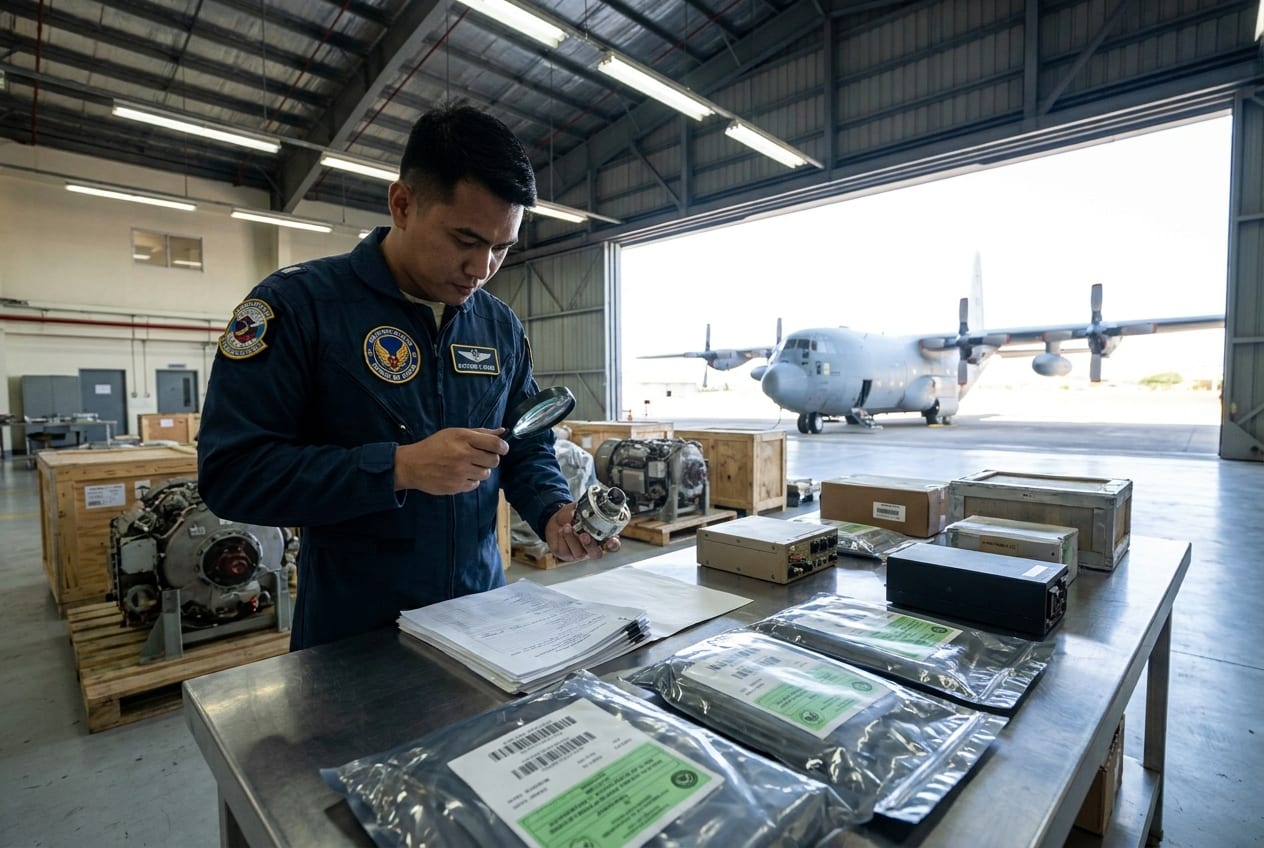
OEM certification is the non-negotiable baseline for any aircraft spare part entering Philippine military or civil aviation service. An OEM-certified part is one manufactured by the original equipment manufacturer or a licensed production approval holder (PAH) under an approved design, accompanied by documentation that establishes an unbroken chain of custody from the production facility to the Philippine end-user.
Required Traceability Documentation
For CAAP-regulated civil aircraft, the minimum traceability package for each part includes: (1) the authorized release certificate (FAA Form 8130-3 or EASA Form 1); (2) the manufacturer's certificate of conformance (CoC); (3) the shipping documentation linking the part serial or batch number to the release certificate; and (4) the supplier's statement of condition. For PAF and AFP military aviation assets, additional documentation layers apply, including the OEM's material test report, the export license or license exemption citation, and the EUC reference number.
Unapproved Parts: The Regulatory and Safety Risk
The FAA defines an unapproved part as any part, component, or material that does not meet the requirements of its approved design or has not been produced under FAA production approval. CAAP mirrors this definition under its CAR framework. The use of unapproved parts — including counterfeit, suspected unapproved parts (SUPs), and parts removed from unknown-history aircraft — constitutes an airworthiness violation and, in AFP contexts, a potential breach of procurement integrity rules under RA 9184 Section 65 (Corrupt Practices). The Philippine aviation market has documented cases of SUP infiltration through gray-market brokers; procurement officers must verify supplier approval status before award.
Approved Supplier Qualification for Philippine Buyers
Philippine government procurement regulations require that suppliers of aircraft spare parts demonstrate specific qualifications before contract award. Under RA 9184 and its IRR, eligible suppliers must be registered with PhilGEPS, possess a valid Mayor's Permit and BIR registration, and submit documentary evidence of their authorization to distribute the specific OEM product line being procured.
OEM Authorization Documentation
For AFP and PAF procurement, the supplier must present a current OEM distributor authorization letter — a formal instrument issued by the foreign manufacturer designating the Philippine entity as its authorized representative for the specific product category and territory. This authorization must be product-specific, not generic; a distributor authorized for avionics components cannot supply engine parts under the same authorization. The authorization letter must be notarized or apostilled in the country of issuance and authenticated by the Philippine DFA.
CAAP-Recognized Suppliers
For civil aviation MRO and operator procurement, CAAP CAR Part 145 requires that approved maintenance organizations (AMOs) source parts only from suppliers that meet the organization's approved supplier list (ASL) criteria, which typically include FAA/EASA-approved repair stations, OEM-authorized distributors, and CAAP-recognized aviation parts suppliers. Suppliers not on the AMO's ASL require a one-time approval process involving supplier audit or documentary review before parts can be accepted.
PhilGEPS Procurement Process for Aircraft Spare Parts
All AFP and Philippine government agency procurement of aircraft spare parts above the small-value procurement threshold — currently PHP 1,000,000 for goods under the RA 9184 IRR — must be conducted through PhilGEPS, the Philippine Government Electronic Procurement System administered by the Government Procurement Policy Board (GPPB).
Competitive Bidding Procedure
The standard PhilGEPS competitive bidding process for aircraft spare parts follows a defined sequence: (1) publication of the Invitation to Bid (ITB) on PhilGEPS for a minimum of seven calendar days for goods; (2) pre-bid conference for technically complex procurements; (3) submission and opening of bids; (4) post-qualification of the lowest calculated bid, which for aircraft parts includes verification of OEM authorization, traceability documentation, and export license status; and (5) contract award and Notice to Proceed (NTP) issuance. The Bids and Awards Committee (BAC) of the procuring entity is responsible for the entire process and must document each stage in the PhilGEPS system.
Direct Contracting for Proprietary OEM Parts
Section 50 of RA 9184 authorizes direct contracting — procurement without competitive bidding — when the goods are proprietary in nature and can only be obtained from the proprietary source. Aircraft spare parts that are sole-sourced from the OEM — such as platform-specific avionics modules, airframe structural components, or manufacturer-exclusive engine parts — qualify for direct contracting, provided the BAC issues a resolution certifying the proprietary nature of the item and the absence of a competitive substitute. This is the most commonly used alternative procurement method for PAF spare parts acquisitions and requires GPPB approval for procurements above specified thresholds.
Key Aircraft Component Categories and Compliance Requirements
Philippine military and civil aviation operators source components across five primary categories, each carrying distinct compliance requirements.
Avionics and Navigation Systems
Avionics components — including flight management systems, radar systems, communications equipment, and electronic warfare suites on military platforms — are among the most tightly controlled categories under ITAR. PAF avionics procurement typically requires a DDTC export license, a government-to-government EUC, and, for certain systems, a Technology Assistance Agreement (TAA) or Manufacturing License Agreement (MLA) between the US manufacturer and the Philippine government. Delivery lead times for ITAR-controlled avionics can range from 90 to 180 days from export license approval.
Landing Gear and Hydraulic Systems
Landing gear assemblies and hydraulic system components for both military and civil aircraft require OEM CoC and, for civil aircraft, FAA Form 8130-3 or equivalent authorized release. Overhaul and repair of these components must be performed by FAA/EASA Part 145-approved repair stations, with documentation of the overhaul cycle included in the traceability package.
Engine Components and Propulsion Parts
Engine components — turbine blades, fuel control units, gearboxes — carry life-limited part (LLP) status under both FAA and CAAP regulations, meaning each component has a mandatory retirement life expressed in cycles or hours. Philippine operators must maintain LLP tracking records in conformance with CAAP CAR Part 91 or Part 121, as applicable. For AFP rotary-wing assets such as the S-70i Black Hawk, engine components sourced from General Electric Aviation must be accompanied by GE-issued CoC and FAA Form 8130-3.
Structural and Airframe Parts
Structural components — including control surfaces, fuselage panels, and wing assemblies — require conformity to the aircraft's type certificate data sheet (TCDS) and must be sourced from the OEM or a PMA-approved manufacturer. PMA parts are FAA-approved alternatives to OEM parts and are accepted by CAAP for civil aircraft; however, AFP procurement policy generally restricts PMA parts for military platforms to avoid interoperability and warranty complications.
Military Medical and CASEVAC Equipment
While not aircraft structural components, military medical equipment integrated into PAF medevac and CASEVAC platforms — including onboard trauma systems and patient transport equipment — is subject to both medical device regulations and, where US-origin, potential EAR classification. BGS supplies trauma kits, combat medical systems, and CASEVAC gear to AFP and national security agency clients as part of its broader defense supply portfolio.
AFP Modernization Programs and Spare Parts Demand Drivers in 2026
The AFP's ongoing Revised Armed Forces of the Philippines Modernization Program (RAFPMP), authorized under Republic Act No. 10349 (AFP Modernization Act), drives the primary demand for aircraft spare parts in the Philippine defense sector. The RAFPMP's Horizon 3 phase (2023–2028) includes sustained investment in PAF fleet sustainment, with platforms including the FA-50 Fighting Eagle, S-70i Black Hawk, AW109 Power, and Cessna T-41D requiring continuous spare parts support. The DND's 2026 budget allocation for AFP modernization — which includes aviation sustainment — reflects the government's commitment to maintaining operational readiness across these platforms.
The Philippine government's increased defense spending, driven by South China Sea territorial disputes and internal security requirements, has accelerated spare parts procurement timelines and increased the volume of PhilGEPS tenders for aviation components. Procurement officers managing these tenders face heightened scrutiny on supplier qualification and traceability documentation as GPPB and Commission on Audit (COA) oversight intensifies.
Sourcing OEM Aircraft Spare Parts Through an Authorized Philippine Distributor
For AFP procurement officers and civil aviation operators, sourcing through an officially designated Philippine distributor — rather than directly from a foreign OEM or through an unauthorized broker — provides measurable compliance, logistical, and commercial advantages. An authorized distributor holds a current OEM authorization letter, maintains in-country stock or established supply chain access, and possesses the regulatory expertise to manage ITAR/EAR licensing, EUC processing, and PhilGEPS documentation requirements.
BGS, operating as a Manila-based B2B defense and aerospace supply specialist, functions as the official Philippine distribution arm for US and Israeli defense manufacturers, supplying avionics, landing gear, engine components, and hydraulic systems with full traceability and CAAP compliance. BGS provides end-to-end supply chain management from the foreign OEM to the Philippine government end-user, including PhilGEPS tender monitoring, EUC process guidance, and ITAR/EAR compliance support — capabilities that reduce procurement risk and accelerate contract execution for AFP and PAF logistics units.
Definitions
OEM-Certified Aircraft Spare Part — A component manufactured by the original equipment manufacturer or a licensed production approval holder under an approved design, accompanied by an authorized release certificate (FAA Form 8130-3 or EASA Form 1) and an unbroken traceability chain from the production facility to the end-user. OEM certification is the baseline airworthiness requirement under CAAP Civil Aviation Regulations.
End-User Certificate (EUC) — A government-to-government instrument required for the import of controlled defense articles into the Philippines, certifying the identity of the Philippine end-user, the intended operational use, and a commitment against re-transfer without prior consent of the exporting country's government. EUCs are processed through the DND and DFA for AFP procurement.
ITAR (International Traffic in Arms Regulations) — US federal regulations administered by the Department of State Directorate of Defense Trade Controls governing the export, import, and transfer of defense articles and services listed on the US Munitions List. ITAR applies to the majority of US-origin military aircraft components procured by the AFP and PAF, requiring a State Department export license before shipment to the Philippines.
PhilGEPS (Philippine Government Electronic Procurement System) — The official electronic procurement platform of the Philippine government, administered by the Government Procurement Policy Board, through which all government agencies — including the AFP and DND — are required to post procurement opportunities, receive bids, and award contracts above the small-value threshold under RA 9184.
Suspected Unapproved Part (SUP) — Any aircraft part, component, or material that has not been produced under FAA or CAAP production approval, lacks proper authorized release documentation, or whose origin and airworthiness status cannot be verified through an unbroken traceability chain. Installation of SUPs constitutes an airworthiness violation under CAAP CAR and a procurement integrity breach under RA 9184.
Direct Contracting (RA 9184 Section 50) — An alternative procurement method under the Government Procurement Reform Act that allows government agencies to procure goods directly from a single source without competitive bidding, applicable when the item is proprietary in nature and can only be obtained from the OEM or its authorized distributor. Requires a BAC resolution certifying the proprietary nature of the procurement.
Life-Limited Part (LLP) — An aircraft engine or structural component with a mandatory retirement life expressed in flight cycles or operating hours, as defined by the OEM and approved by the airworthiness authority. Philippine operators must maintain LLP tracking records in conformance with CAAP CAR Part 91 or Part 121, and replacement parts must be sourced with full cycle history documentation.
Military vs. Civil Aviation Spare Parts Procurement Requirements in the Philippines
| Requirement | AFP / PAF Military Procurement | Civil Aviation (CAAP-Regulated) |
|---|---|---|
| Governing Procurement Law | RA 9184 (Government Procurement Reform Act) | Commercial contract law; no RA 9184 obligation |
| Procurement Platform | PhilGEPS mandatory above PHP 1,000,000 | Not required; commercial purchase orders |
| Export Control Regime | ITAR (USML) for most US-origin military parts | EAR (CCL) for dual-use; ITAR for military-spec components |
| End-User Certificate | Required for controlled defense articles; DND/DFA process | Generally not required for civil aviation parts |
| Authorized Release Certificate | FAA Form 8130-3 / EASA Form 1 + OEM CoC | FAA Form 8130-3 / EASA Form 1 mandatory |
| PMA Parts Acceptance | Generally restricted; OEM parts preferred for military platforms | Accepted if FAA-approved; per AMO's approved supplier list |
| Traceability Requirement | Full chain: OEM → export license → EUC → AFP end-user | Full chain: OEM/repair station → CAAP-accepted release |
| Supplier Authorization | OEM distributor authorization letter (apostilled/DFA-authenticated) | AMO approved supplier list qualification |
Key Aircraft Component Categories: Compliance Requirements Summary
| Component Category | Export Control Classification | Release Document Required | LLP Tracking Required |
|---|---|---|---|
| Avionics / Navigation Systems | ITAR (USML Category VIII/XI) for military platforms | FAA Form 8130-3 + DDTC export license | No (unless time-limited) |
| Landing Gear Assemblies | EAR (ECCN 9A991) for civil; ITAR for military | FAA Form 8130-3 / EASA Form 1 | No |
| Engine Components (Turbine) | ITAR for military engines; EAR for civil | FAA Form 8130-3 + OEM CoC | Yes — cycle/hour tracking mandatory |
| Hydraulic Systems | EAR (ECCN 9A991) typically | FAA Form 8130-3 / EASA Form 1 | No |
| Structural / Airframe Parts | ITAR for military airframes; EAR for civil | OEM CoC + conformity to TCDS | Conditional on design specification |
| Electronic Warfare Suites | ITAR (USML Category XI) — strict license required | DDTC export license + EUC mandatory | No |
Frequently Asked Questions
What documentation is required for OEM aircraft spare parts to be accepted by CAAP in the Philippines?
CAAP requires each aircraft spare part to be accompanied by an authorized release certificate — FAA Form 8130-3 for US-origin parts or EASA Form 1 for European-origin components — plus the OEM manufacturer's certificate of conformance and shipping documentation linking the part's serial or batch number to the release certificate. Parts lacking this unbroken traceability chain are classified as suspected unapproved parts (SUPs) and cannot be installed on Philippine-registered aircraft.
Can the AFP or Philippine Air Force procure aircraft spare parts through direct contracting under RA 9184?
Yes. Section 50 of RA 9184 authorizes direct contracting when the spare part is proprietary and can only be sourced from the OEM or its exclusive authorized distributor, with no competitive substitute available. The procuring entity's Bids and Awards Committee must issue a resolution certifying the proprietary nature of the item before direct contracting proceeds, and procurements above defined thresholds require GPPB approval.
What is the difference between ITAR and EAR for Philippine aircraft spare parts procurement?
ITAR, administered by the US Department of State, governs US-origin military defense articles listed on the US Munitions List — including most PAF platform-specific components — and requires a State Department export license for every shipment to the Philippines. EAR, administered by the US Department of Commerce, covers dual-use items on the Commerce Control List and applies to many civil aviation components. Misclassifying an ITAR-controlled part as EAR-only carries penalties of up to USD 1 million per violation.
What is an end-user certificate and when is it required for AFP spare parts procurement?
An end-user certificate (EUC) is a government-to-government instrument certifying the Philippine end-user's identity, intended use, and commitment against unauthorized re-transfer of controlled defense articles. EUCs are required for AFP procurement of ITAR-controlled components and are processed through the Department of National Defense and the Department of Foreign Affairs, with formal coordination with the US Embassy in Manila for ITAR-classified items.
Are PMA (Parts Manufacturer Approval) parts accepted for Philippine Air Force aircraft?
PMA parts — FAA-approved alternative components produced by entities other than the OEM — are generally accepted by CAAP for civil aircraft maintenance. However, AFP and PAF procurement policy typically restricts PMA parts for military platforms to avoid interoperability complications, warranty voidance, and compliance risks associated with ITAR-controlled platform configurations. OEM-sourced components remain the standard for PAF fleet sustainment.
How does PhilGEPS work for aircraft spare parts procurement by Philippine government agencies?
PhilGEPS is the mandatory electronic procurement platform for all Philippine government agencies, including the AFP and DND, for goods procurements above PHP 1,000,000. Procurement of aircraft spare parts follows the competitive bidding sequence: Invitation to Bid publication for a minimum of seven calendar days, bid submission and opening, post-qualification of the lowest bid (including OEM authorization and traceability verification), and contract award. Proprietary OEM parts may qualify for direct contracting under RA 9184 Section 50.
What AFP modernization platforms are driving spare parts demand in 2026?
The AFP's Revised Modernization Program Horizon 3 (2023–2028) under RA 10349 drives primary spare parts demand for the FA-50 Fighting Eagle light combat aircraft, S-70i Black Hawk utility helicopter, AW109 Power helicopter, and Cessna T-41D trainer. These platforms require continuous OEM-certified component support, and their US and Israeli origin means the majority of spare parts are subject to ITAR or EAR export control compliance requirements.
Key Takeaways
- OEM certification and full traceability documentation — including FAA Form 8130-3 or EASA Form 1 and an unbroken chain of custody — are mandatory for all aircraft spare parts entering service on Philippine-registered civil or military aircraft under CAAP regulations.
- AFP and PAF spare parts procurement must comply with RA 9184 in full, with competitive bidding through PhilGEPS as the default mode and direct contracting under Section 50 available only for proprietary OEM-sourced components supported by a BAC resolution.
- US-origin military aircraft components are governed by ITAR, requiring a US Department of State export license and a government-to-government end-user certificate processed through the DND and DFA before any shipment to the Philippines.
- Suspected unapproved parts (SUPs) and gray-market components pose both airworthiness and procurement integrity risks; Philippine procurement officers must verify supplier OEM authorization status and traceability documentation before contract award.
- The AFP's Revised Modernization Program Horizon 3 (2023–2028) under RA 10349 is the primary demand driver for aircraft spare parts in 2026, with FA-50, S-70i Black Hawk, and AW109 Power platforms requiring sustained OEM-certified component supply.
- Sourcing through an officially designated Philippine OEM distributor — one holding a current, product-specific, apostilled authorization letter — reduces ITAR/EAR compliance risk, accelerates EUC processing, and satisfies RA 9184 post-qualification requirements for government procurement.
Sources
- Civil Aviation Authority of the Philippines (CAAP) — Official Website
- Government Procurement Policy Board (GPPB) — RA 9184 and Implementing Rules
- US Department of State — Directorate of Defense Trade Controls (DDTC) ITAR
- Philippine Government Electronic Procurement System (PhilGEPS)
- US Department of Commerce Bureau of Industry and Security (BIS) — Export Administration Regulations